Rethinking Outpatient Strategy: How RHC, HOPD, and FQHC Look-Alike Designations Impact Hospital Margins
Summary: Hospitals can improve margins and patient access by choosing the right outpatient strategy: a Rural Health Clinic (RHC), Hospital Outpatient Department (HOPD), or Federally Qualified Health Center Look-Alike (FQHC Look-Alike). Each model has distinct reimbursement structures, regulatory requirements, and operational considerations, and the right fit depends on an organization’s payer mix, patient population, and long-term goals. For organizations with high Medicaid or uninsured patient volumes, FQHC Look-Alikes offer strong potential for sustainable financial performance, with higher reimbursement, 340B drug pricing access, and expanded care for underserved populations.
As hospitals face sustained margin pressure, many organizations continue to focus on improving outpatient performance through operational improvements such as cost reduction, staffing optimization, and revenue cycle enhancements. These efforts target the cost and efficiency side of the margin equation. However, a separate lever – structural strategies – targets the reimbursement architecture itself and can work alongside operational efforts to help strengthen long-term financial sustainability.
Rethinking Outpatient Structure as a Financial Driver
Outpatient designations – including Rural Health Clinics (RHCs), Hospital Outpatient Departments (HOPDs), and Federally Qualified Health Center Look-Alike (FQHC Look-Alike) models – represent strategic options organizations can evaluate alongside operational, clinical, and financial improvement initiatives to strengthen reimbursement, patient access, and long-term sustainability.

The Strategic Role of Outpatient Designations
Today’s outpatient clinics extend far beyond access, serving simultaneously as revenue engines, cost centers, and critical components of a community health strategy. A clinic’s designation directly shapes:
- Reimbursement methodology and rate structure
- Financial viability across payer mixes
- Operational and compliance requirements
- Patient access
- Long-term sustainability
Choosing the right model is a strategic decision that should align financial performance with community needs.
Understanding the Models: A High-Level Overview
While each model serves a distinct purpose, their differences have significant financial and operational implications.
| Category | Rural Health Clinic | Hospital Outpatient Department | Federally Qualified Health Center Look-Alike |
|---|---|---|---|
Purpose |
Expands access to rural and underserved areas | Delivers outpatient services under hospital provider-based billing | Meets Health Resources and Services Administration (HRSA) Health Center requirements while improving access and reimbursement |
Medicare Reimbursement |
Receives cost-based reimbursement for Medicare and Medicaid services | Uses Outpatient Prospective Payment System (OPPS) reimbursement through provider-based billing | Operates under a prospective payment system |
Reimbursement Level |
Modest reimbursement; limited reimbursement potential |
Higher reimbursement; greater reimbursement potential |
Improved reimbursement; strongest reimbursement potential |
Additional Revenue |
Offers no additional revenue programs | Allows hospital professional and facility fee billing | Provides 340B Drug Pricing Program eligibility |
Patient Access |
Enhances access in underserved communities | May reduce access for some patients | Supports access and community health goals |
Where the Models Diverge
The differences between these outpatient models are most evident across four key dimensions:
- Reimbursement Mechanics: Reimbursement is the most significant driver of financial performance, with FQHC Look-Alikes typically offering the highest potential return due to enhanced Prospective Payment System (PPS) rates and 340B eligibility.
- Regulatory and Compliance Requirements: Each model carries distinct oversight obligations, from Centers for Medicare & Medicaid Services (CMS) certification for RHCs to HRSA governance and reporting requirements for FQHC Look-Alikes.
- Operational Complexity: FQHC Look-Alikes require expanded service lines, quality reporting, and governance structures, while RHCs and HOPDs are comparatively less complex.
- Strategic Flexibility: The models differ in purpose: RHCs address rural access, HOPDs support specialty expansion, and FQHC Look-Alikes advance safety-net transformation.
- Patient Access and Affordability: Patient access varies across models due to differences in billing structures and cost-sharing implications. HOPDs, which often generate both facility and professional fees, may create higher out-of-pocket costs for patients, potentially impacting utilization. In contrast, RHCs and FQHC Look-Alikes are designed to reduce financial barriers to care, with FQHC Look-Alikes offering sliding fee scales and enhanced access for underserved populations.
Why FQHC Look-Alike Is Gaining Attention
Among the available options, the FQHC Look-Alike model is gaining traction as organizations look for more sustainable ways to address margin pressure while expanding access. For organizations that meet the eligibility requirements, it can be an important strategy to evaluate alongside other operational and financial improvement strategies.
Key features of FQHC Look-Alikes, such as higher Medicare and Medicaid reimbursements, access to the 340B Drug Pricing Program, and reduced bad debt from required sliding fee scales, contribute to more stable and predictable revenue streams.
This model is particularly well-suited for:
- Organizations with high Medicaid or uninsured patient volumes
- Hospitals experiencing frequent emergency department utilization for primary care
- Clinics operating at a loss, near break-even, or with persistent physician practice losses
- Systems seeking to expand access to behavioral health, dental, and primary care services
The benefits come with added complexity. Organizations are required to comply with HRSA governance standards, including establishing a patient-majority board, expanding services, and strengthening compliance and reporting infrastructure.
For many, this represents a structural transformation as well as a financial shift.
A Framework for Choosing the Right Model
Selecting the appropriate outpatient designation requires a structured, organization-specific evaluation.
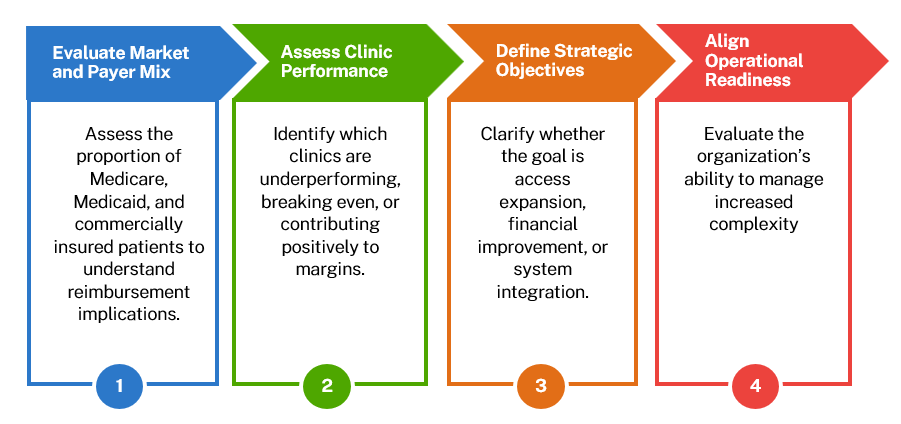
Despite the importance of outpatient designations, organizations frequently approach these decisions with a limited perspective. Common missteps include:
- Treating designations as administrative or compliance-driven decisions
- Underestimating implementation timelines and operational complexity
- Focusing on short-term margin improvement instead of long-term structural alignment
- Failing to align finance, operations, and community strategy
These gaps can significantly limit the effectiveness of any chosen model.
From Optimization to Transformation
The greatest opportunities often come from combining operational excellence with strategic decisions about how care is structured, delivered, and reimbursed. By aligning outpatient models with payer mix, patient populations, and long-term strategic goals, healthcare organizations can move beyond optimization toward true transformation.
Now is the time to ask: Is your outpatient model aligned with your financial challenges and community needs?
Analyzing and navigating these models is complex because each involves distinct reimbursement structures, regulatory requirements, and operational considerations, and implementation typically engages multiple stakeholders across finance, operations, compliance, and clinical leadership. Having the support of an experienced third-party consultant can be critical to a successful outcome.
KSM’s healthcare consulting team has real-world experience helping organizations evaluate a broad range of performance improvement opportunities – from operational optimization and physician enterprise strategy to outpatient reimbursement models. For organizations exploring whether one of these reimbursement models could strengthen long-term financial sustainability, our team can help determine which approach best aligns with your goals. Contact us to start the conversation.
Related Content
Where Ownership
Meets Opportunity
At KSM, you’re more than an employee, you’re a firm owner.