Infrastructure Readiness in Indiana: The New Standard for Economic Competitiveness
Summary: Infrastructure is a critical driver of economic development in Indiana, directly affecting site readiness, business investment, housing growth, workforce attraction, and long-term competitiveness. As communities face aging infrastructure, funding constraints, and rising demand from AI data centers and other growth industries, strategic infrastructure planning has become essential for sustainable economic growth and quality of life.
Infrastructure is no longer simply a public works issue. Across Indiana, it has become a defining factor shaping economic competitiveness, housing growth, workforce attraction, and long-term fiscal sustainability.
KSM’s “State of Local Government in Indiana: 2025 Report” found that infrastructure investment ranked as the second-highest priority among Indiana local governments, with nearly four in 10 leaders identifying aging infrastructure as a major challenge. Smaller communities reported significant pressure from aging systems and limited capital resources.
This reflects a broader shift happening nationally. Communities are no longer competing solely on incentives or tax rates. Increasingly, they compete based on their ability to support growth through modern infrastructure, utility capacity, housing availability, and quality-of-place investments.
Why Infrastructure Is Now an Economic Development Strategy
For decades, infrastructure was viewed largely through a maintenance lens focused on repairing roads, replacing pipes, and sustaining public facilities. Today, communities increasingly view infrastructure as a strategic asset tied directly to economic development.
Communities that align infrastructure investment with long-term growth goals are better positioned to attract private capital, support housing development, and compete for emerging industries.
This is especially true as businesses and residents become more mobile and as site selection timelines accelerate. Economic development today is increasingly driven by ecosystems rather than isolated projects. Although most discussions in recent years have centered around talent, which remains a critical factor, employers are evaluating factors beyond labor costs, including:
- Utility capacity and reliability
- Broadband access
- Transportation access
- Housing availability
- Community identity
- Workforce availability
- Quality of place
In many cases, a lack of available sites or infrastructure readiness prevents communities from advancing in the site selection process.
The “State of Local Government in Indiana: 2025 Report” reinforces this reality. Local leaders identified water and sewer systems, roads and bridges, and stormwater systems as the top three infrastructure priorities during the next three years.
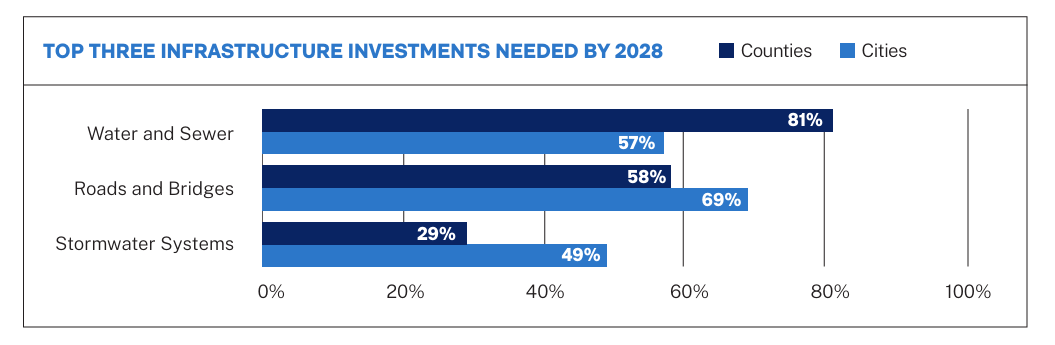
Infrastructure demand is shaped by more than industrial growth and emerging technologies. Communities must create desirable places for people to live, learn, work, and play. Public spaces, walkable downtowns, broadband, parks and trails, housing, schools, and other community amenities all influence workforce attraction and long-term competitiveness. As a result, infrastructure investments play a critical role in economic competitiveness and quality of life.
People increasingly choose to live in places based on experience and identity, and employers follow talent. Therefore, infrastructure serves both economic and community-building functions. The communities that succeed long term will be those that balance economic competitiveness with investments that improve daily quality of life.
Site Readiness: Why Shovel-Ready Communities Win More Projects
Shovel-ready infrastructure has become increasingly important in Indiana’s economic development environment.
Modern site selection processes move rapidly, often narrowing from large regions to a handful of viable sites within weeks. Communities lacking infrastructure certainty may be eliminated before meaningful discussions occur.
Many Indiana communities lose projects because of:
- Insufficient water or wastewater capacity
- Limited electric infrastructure
- Lack of available industrial sites
- Broadband deficiencies
- Delays in approvals and development timelines
Prepared communities are winning economic development investment because they reduce uncertainty.
This is especially important for logistics, advanced manufacturing, mixed-use development, housing, and redevelopment projects, all of which require coordinated infrastructure planning long before a project announcement occurs.

Smaller Indiana Communities Face the Greatest Infrastructure Pressure
Infrastructure challenges are not distributed evenly across Indiana. KSM’s 2025 report found that 49% of smaller communities identified aging infrastructure as a significant concern compared to 21% of larger jurisdictions.
Smaller communities often face narrower tax bases, limited staffing and planning capacity, reduced access to capital, and greater dependence on state and federal funding. Aging infrastructure limits growth opportunities, and limited growth reduces resources for modernization.
The report also found that two-thirds of Indiana communities report limited funds for infrastructure upgrades. Rising construction costs, inflationary pressures, and uncertainty around long-term federal funding only compound the challenge.
How AI and Data Centers Are Reshaping Indiana’s Infrastructure Demands
Artificial intelligence is rapidly reshaping infrastructure demand across the United States, and Indiana is directly impacted by that shift.
According to the International Energy Agency, data centers are expected to account for nearly half of U.S. electricity demand growth through 2030. Indiana has already attracted major hyperscale investments from AWS, Google, Meta, and Microsoft.
These projects reinforce Indiana’s growing role in the digital economy while creating new infrastructure demands. AI-focused data centers require significant electricity, water, high-speed fiber, land, cooling, and transmission capacity.
For local governments, this introduces infrastructure questions that extend far beyond traditional economic development considerations:
- Can the electric grid support large-load users without shifting costs to residents?
- Can water and wastewater systems sustain long-term demand?
- How should communities evaluate tax benefits versus infrastructure strain?
- What happens when multiple hyperscale users compete for finite utility capacity?
Still, AI demand is only one part of the broader infrastructure equation. Communities should not plan infrastructure solely around data centers or emerging technologies. Thoughtful growth requires communities to evaluate infrastructure needs holistically and ensure investments support broader long-term community goals. The same systems that support industrial growth must also support housing, workforce development, schools, healthcare access, downtown revitalization, transportation, community services, and quality-of-life amenities.
Infrastructure planning should focus on creating resilient communities that can adapt to changing economic conditions while remaining desirable places to live and work.
Public-Private Partnerships Are Bridging Infrastructure Funding Gaps
As infrastructure needs continue to outpace available public funding, local governments are increasingly relying on partnerships to advance projects. Public-private partnerships are becoming essential because they allow communities to reduce development risk, coordinate infrastructure investment, assemble land, support catalytic projects, and better align public benefit with private investment.
Indiana communities are already applying these strategies through downtown revitalization initiatives, mixed-use town center projects, industrial and logistics developments, brownfield redevelopment, and housing-focused redevelopment efforts. The communities seeing the greatest success are often those that proactively align infrastructure, land use, and economic development strategy rather than reacting project-by-project.
How Indiana Communities Can Prioritize Infrastructure Investments
With infrastructure needs outpacing available resources, strategic project prioritization has become increasingly important for Indiana communities.
KSM’s 2025 report suggests that communities:
- Conduct asset condition audits and formalize project pipelines
- Coordinate regionally on infrastructure investments
- Align capital planning with economic goals
- Strengthen long-term infrastructure planning capacity
Communities best positioned for future growth will likely be those that plan proactively rather than reactively, align infrastructure investments with long-term land-use goals, coordinate regionally, build site readiness, align infrastructure investments with long-term goals, and treat infrastructure as a competitiveness tool.
Planning for Indiana’s Infrastructure Future
Indiana’s local governments recognize the importance of infrastructure investment. The question now is how communities will prioritize, fund, and coordinate the investments needed to remain competitive.
Infrastructure today shapes economic opportunity, talent attraction, housing growth, fiscal sustainability, quality of place, and long-term competitiveness. Communities that balance economic opportunity with long-term infrastructure capacity and community outcomes will be best positioned for sustainable success.
KSM’s government consulting team helps local governments align infrastructure planning with capital investment, site readiness, fiscal sustainability, and community development goals.
Connect with us to learn how KSM can support your infrastructure and capital planning needs.
Related Content
Where Ownership
Meets Opportunity
At KSM, you’re more than an employee, you’re a firm owner.