Factors That Fuel Trucking Company Valuations in Today’s Market
Summary: Trucking company valuations are shaped by far more than industry multiples. Understanding key valuation methods can help owners assess their trucking company’s value and make more informed business decisions. Cash flow, fleet condition, customer relationships, management experience, technology, and debt all play a role in strengthening profitability, resilience, and long-term business value.
For owners of privately held transportation companies, understanding business value is an important part of long-term planning. Whether preparing for a future sale, transitioning ownership, or measuring the success of strategic initiatives, knowing what drives company value remains a key consideration.
Following record freight demand in 2021 and 2022, the trucking industry entered a prolonged freight downturn marked by declining rates, excess capacity, and tightening operating margins. During 2026, capacity began to rationalize as financially strained carriers exited the market, contributing to improving spot rates and a more balanced supply-and-demand environment.
However, the recovery has been driven more by reduced capacity than by broad-based growth in freight demand. Carriers continue to face elevated fuel, insurance, labor, equipment, and maintenance costs, leaving operating margins under pressure despite improving rates.
Understanding Trucking Company Value
Buyers and sellers of trucking companies consider a range of factors when determining value. Some are quantitative, such as net book value and free cash flow margins. Others are qualitative, including driver quality, customer relationships, and management experience. Although these qualitative factors cannot always be easily measured, they often separate the most valuable companies from the pack.
Three general methods of valuation are most commonly used to translate these quantitative and qualitative factors into a company’s overall value.
Three General Valuation Methods
1. Income Method
What cash flow can a business generate for a buyer? Historical cash flow performance provides a foundation for developing a meaningful forecast. No forecast is perfect, but analyzing the company’s cash-generating capacity can help buyers – and sellers – better understand the opportunities and risks ahead.
Specific to trucking companies, buyers should evaluate how effectively the company has managed fluctuations in operating costs. The ability to recover changes in fuel costs through fuel surcharge programs or customer pricing arrangements can have a meaningful impact on future cash flow and should be considered when developing financial projections.
Fleet replacement is another important consideration. Earnings before interest, taxes, depreciation and amortization (EBITDA) alone does not factor in an aging fleet that will require significant capital expenditures to replace tractors and trailers.
Analysis of projected net working capital is also required to gauge the future levels of free cash flow that a buyer would expect after a transaction. Current cost trends also make normalized earnings analysis more important. Buyers should distinguish temporary market-driven improvements from durable margin gains and test whether the company’s pricing, safety program, and maintenance practices can absorb these pressures.
2. Market Method
The value of publicly traded transportation companies is determined every day in the stock market. Real-time market information also has an impact on the value of smaller, privately held trucking companies. However, these stock market valuations are not always appropriate guides for the value of privately held companies due to the larger size and diversified operations of public companies.
There are many transportation companies that are privately held and not publicly traded. Transaction data on the sale prices for privately held trucking companies can provide a guidepost for valuation multiples. These multiples may be calculated based on a number of factors such as revenues, earnings, cash flow, or book value.
However, transactions occur at a broad range of valuation multiples, so proceed with caution when using a valuation multiple as anything more than an approximate indication of value. As an example, data from DealStats, a leading private company transaction database, is highlighted in the accompanying chart. While the median EBITDA margin peaked in 2022 before declining over the following three years, median valuation multiples generally trended upward through 2025. This illustrates that transaction multiples are influenced by many factors beyond current profitability.
Every transaction is unique, and comparisons require careful consideration of the underlying facts and circumstances. In trucking, buyers should also test whether reported EBITDA reflects a normalized freight cycle and whether deferred fleet replacement will require material post-closing capital expenditures.
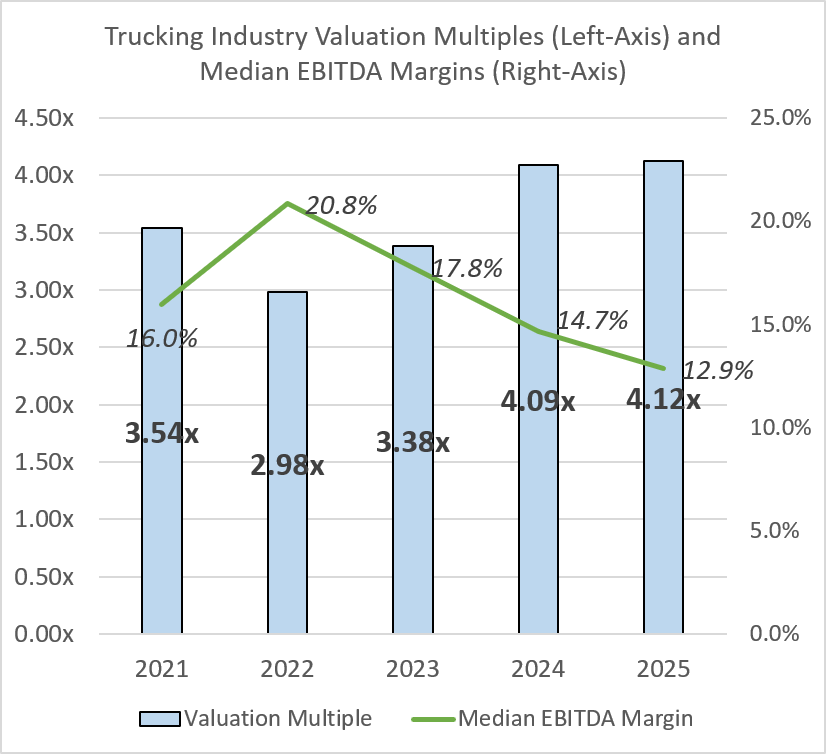
DealStats data underscores just how widely transaction multiples can vary. During the past five years, observed EBITDA multiples ranged from less than 1.0x to more than 20x. That wide range illustrates why applying a general industry multiple to a company’s EBITDA can be misleading.
Company-specific factors including earnings quality, fleet condition, customer concentration, management depth, and future capital requirements can have a significant effect on what a buyer is willing to pay.
3. Asset Method
The asset method considers one of the most fundamental measures of company value: the market value of its assets less its liabilities.
For trucking companies, this analysis should consider the market value of transportation equipment as well as the costs associated with selling that equipment. The resulting Adjusted Book Value can serve as a potential floor, or lower end, of the valuation range. Any value attributed to the business above Adjusted Book Value generally represents intangible value, or goodwill.
Value Drivers: How Does a Trucking Owner Grow Company Value?
Positive Cash Flow
Profits are good, but cash flow pays the bills. Efficient operations will convert net income (as shown on the income statement) to cash flow. Converting receivables to cash and efficiently managing the level of capital equipment are keys to positive cash flow. In a tight-margin environment, small differences in rate discipline, equipment utilization, empty miles, maintenance expense, and fuel recovery can have a significant effect on cash flow.
Owners should understand profitability by customer and equipment type, not merely in the aggregate. A company that demonstrates consistent cost control and produces reliable cash flow through freight cycles will generally be more attractive to prospective buyers.
Develop Tangible and Intangible Assets
While it is easy to focus on tangible assets such as cash, working capital, and equipment, the development of intangible assets cannot be overlooked. Prospective buyers of the company will care about issues such as the quality, experience and tenure of its drivers, long-standing customer relationships, and the know-how that comes from an experienced management team.
Buyers are also increasingly interested in companies that leverage technology to improve efficiency and decision-making. Investments in transportation management systems (TMS), telematics, and other operational technologies can improve efficiency, strengthen performance, and ultimately enhance company value.
Manage Debt
The valuation multiples discussed in this article relate to the debt-free value of a business. Trucking companies often must use financing to purchase equipment, making debt an important tool for funding fleet investments. However, too much debt can reduce financial flexibility and increase risk during periods of economic uncertainty. Maintaining an appropriate balance between debt and equity helps support a healthy balance sheet and positions the company for long-term success.
Building Value for the Long Term
Ultimately, the value of a trucking company cannot be reduced to a single formula or industry multiple. Buyers consider a company’s cash-generating ability, underlying assets, and market evidence, but they also look closely at the quality and sustainability of the business itself.
For owners, that means building value is an ongoing process, not something that begins when it’s time to sell. Consistent cash flow, disciplined cost management, a well-maintained fleet, strong customer relationships, experienced drivers and management, effective use of technology, and a healthy balance sheet can all contribute to a more valuable and resilient company. Owners who focus on these fundamentals will be better positioned not only to pursue a future transaction but also to navigate changing freight cycles and create long-term value along the route.
Explore Your Trucking Company’s Value
To learn more about the value of your transportation company and the factors that drive your profitability and growth, contact your KSM advisor or complete the form below.
Related Content
Where Ownership
Meets Opportunity
At KSM, you’re more than an employee, you’re a firm owner.